
How People Search Has Changed: 3 Things Vancouver Businesses Should Know About AI Search
Search has quietly changed. People still type into Google, but a growing share now ask ChatGPT, Gemini or Perplexity and take the first name they are given.
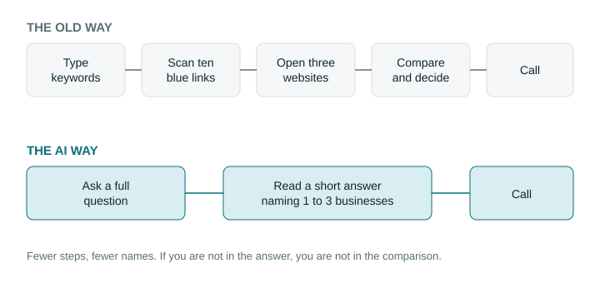
For 25 years I have watched people find local businesses the same way. They type a few words into Google, scan ten blue links, open two or three, and call someone. Everything we built for small business marketing, from websites to Google Business Profiles to local SEO, was designed around that habit.
That habit is changing faster than most business owners realize.
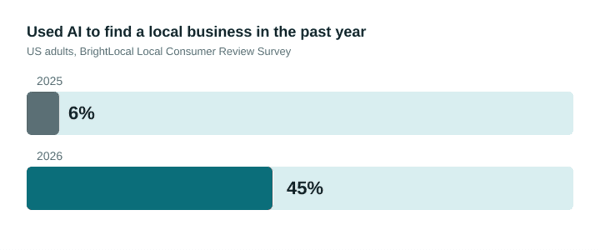
In one year, AI went from a curiosity to a routine way of finding local businesses.
What the numbers say
BrightLocal’s 2026 Local Consumer Review Survey asked 1,002 US adults whether they had used ChatGPT, Gemini, Perplexity or a similar tool to find a local business in the past year. 45 percent said yes. The year before, the figure was 6 percent.
That is not a trend line. That is a switch being flipped. Add to it that Google itself now puts AI-written answers at the top of many results, and the first thing a customer reads is often not a list of websites at all.

How People Search Has Changed
Searching is turning into asking
The difference is more than technology. It changes what the customer does.
With a traditional search, someone types “roofer North Vancouver” and does the comparison work themselves. With an AI assistant they write a full question: Who is a reliable roofer in North Vancouver that handles heritage homes and answers quickly? The assistant does the comparison and hands back a short answer, often just a few names, sometimes only one.
Why the old methods return weaker results
None of this means Google is dead. Google’s query volume is still enormous, and it is folding AI answers into its own results. What has changed is what a high ranking is worth.
- More searches end without a click. SparkToro and Similarweb data put the share of US Google searches that end with no click to any website at 68 percent in early 2026. In Google’s AI Mode the share is reported to be far higher still.
- Position one is worth less. Studies of searches that show an AI Overview report a sharp drop in click rates for the top organic result.
- The list is shorter. When an assistant names one or two businesses, there is no page two, and often no real page one.
So a business can do everything the old playbook asked, hold a good ranking and a decent website, and still see fewer calls because the customer never got as far as the list.
A good ranking used to put you on the shortlist. Now the shortlist is written by an AI, and it uses different rules.
What I tell my clients
Do not panic and do not abandon what works. A complete, active Google Business Profile, honest reviews and a clear website still matter, and as the next post explains, they are the raw material AI tools draw on. What changes is the goal. It is no longer only to rank. It is to be the business an assistant is confident enough to name.
That is what AI search visibility means: how often, and how accurately, AI tools mention your business when someone asks about what you do in the area you serve.
Try this today. Every week I run a simple test: I open ChatGPT, Gemini and Perplexity and ask the question a local customer would ask, in Vancouver or North Vancouver. I note whether the business is named and whether what it says is correct. Do the same for yours. Ten minutes will tell you more than any ranking report.
Conclusion
Call 604-359-2239 or book at 99digital.ca to get started.
Geoff Lee is the CEO of 99 Digital Inc. in North Vancouver, BC. He has been helping local businesses get found online for more than 25 years.